By TruckCrash News Desk · Published July 23, 2026 · Updated if authorities revise details
What Happened
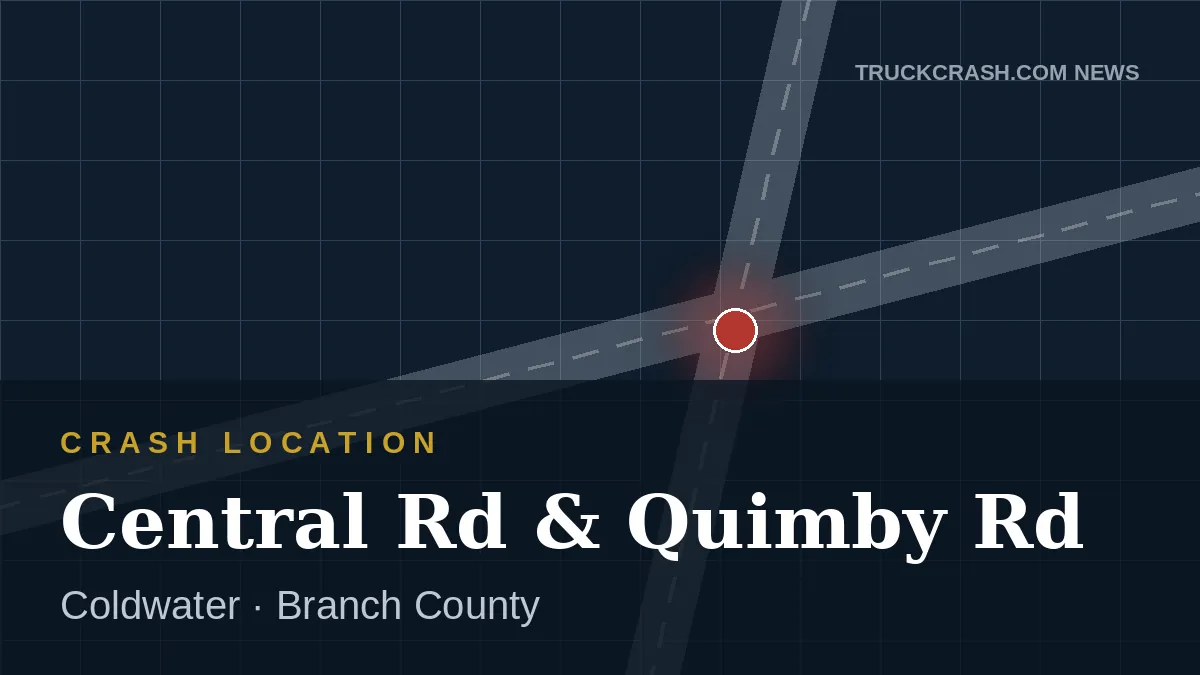
One driver was hospitalized after a two-vehicle crash at the intersection of Central and Quimby roads in the Coldwater area Wednesday morning, according to the Branch County Sheriff’s Office, as reported by WTVB.
Deputies said a 2014 Chevrolet Silverado driven by a 45-year-old Bronson man was headed north on Quimby Road when it failed to stop at a stop sign and collided with an eastbound 2023 Chevrolet Malibu, per the report. The Malibu’s driver, a 40-year-old Bronson man, was taken to a hospital with injuries described as non-life-threatening.
The pickup’s driver sustained minor injuries and declined treatment at the scene, WTVB reported. The Lakeland Fire Department, LifeCare Ambulance, Branch County Central Dispatch, and two towing services also responded. Reporting: WTVB, with information from the Branch County Sheriff’s Office.
The Investigation: What Happens Next
The Branch County Sheriff’s Office documented the crash, and its report attributes the collision to the pickup failing to stop at the stop sign, per WTVB. In intersection crashes like this, any enforcement decision — such as a citation — typically follows the completed report; none had been announced in the initial coverage.
Investigators in stop-sign collisions generally record vehicle rest positions, damage angles, and sight distances at the intersection, and both drivers’ accounts become part of the record reviewed by the prosecutor or traffic division if injuries later prove more serious.
The Legal Picture
Who could be responsible in crashes like this? In crashes like this — where police report one vehicle failed to stop at a posted sign — the legal questions usually center on right-of-way at the intersection, each driver’s speed and attentiveness, and whether anything obstructed the sign or sight lines. Fault in any specific crash is determined by the full investigation and, if disputed, by insurers or courts.
What evidence tends to matter? The sheriff’s crash report, photographs of the vehicles’ final positions, event data recorders (most late-model vehicles like a 2023 Malibu store pre-impact speed and braking data), and statements from the drivers and any witnesses are typically the key evidence.
What Michigan rules apply? Under Michigan’s no-fault system, each injured driver generally looks first to personal injury protection benefits for medical care and lost wages regardless of fault, while claims against another driver require meeting the state’s injury threshold — our guide to Michigan no-fault insurance explains how that framework works.
Nothing in this section is a statement about who was at fault in this specific crash. Responsibility is a legal question that depends on the full investigation, and no assumptions should be made about any driver, company, or agency involved.
This Stretch of Road
Central and Quimby roads meet in the farm country outside Coldwater in Branch County, part of a grid of two-lane county roads where minor intersections are controlled by stop signs rather than signals. Crashes at rural stop-sign intersections are a persistent pattern in Michigan crash data because approach speeds are highway-like and cross-traffic can be infrequent enough that drivers stop scanning for it.
This was the second injury crash reported in the Coldwater area in recent days; a moped rider was critically hurt in a separate collision north of the city earlier in the week.
If You Saw This Crash
Anyone who witnessed Wednesday morning’s collision at Central and Quimby roads can contact the Branch County Sheriff’s Office to add their account to the investigation file.
About TruckCrash News. TruckCrash News tracks and reports on truck and traffic crashes across Michigan every day, so that families, commuters, and safety advocates can see what is happening on our roads. Coverage is compiled from official releases and credible local reporting, and stories are corrected if authorities revise their accounts.
Informational content only — not legal advice and not a solicitation. This article reports publicly available information and does not create an attorney-client relationship.